One of the biggest safety challenges in the electric power industry is managing the risks posed by unwanted electrical discharges. With an increasing move towards renewable energy sources, such as solar, wind and biogas, there is a need for many more individual connections to the national electrical grid, which means the need for more switchgears. Switchgears contain a combination of fuses, switches, circuit breakers, etc., and can be used to switch on or off certain pieces of equipment, or, in the case of a fault, to de-energise equipment from the huge voltages handled at power stations.
One typical switchgear design, the gas-insulated switchgear, uses a refrigerant gas, sulfur hexafluoride (SF6), as an insulator. Owing to its very large dielectric constant, SF6, is a very good insulator and so it has found widespread use in switchgears that need very high voltage handling capabilities.1 It is very chemically inert and therefore compatible with the materials used for building the switchgears, though SF6 can form decomposition products in some environments, when equipment defects have started to occur.2
Switchgears using SF6 insulators are typically particularly low noise, very low maintenance and can be used with very high voltages, which is what has led to the widespread use of SF6-based switchgear designs.1 However, there are some significant issues surrounding the use of refrigerant gases such as SF6. SF6 is a potent greenhouse gas, with a global warming potential 23,500 times that of carbon dioxide when compared over a one-hundred-year period and, like most of the chlorofluorocarbon (CFC) gases, it is incredibly persistent in the atmosphere, with an atmospheric lifetime of about 3200 years.3
Industrial Sources of SF6
The long atmospheric lifetime of SF6 and the lack of natural decomposition routes for it mean that SF6 concentrations in the atmosphere have continued to rise. Concerns about its contribution to global warming and the lack of methods for removing it from the atmosphere led to an EU-wide ban on the use of SF6 in 2014, with an exception for the electrical industry as it was considered there was not a suitable replacement chemical at the time.4 In order to try and monitor SF6 usage, with a view to phasing out the use of the gas when possible, countries are now required to report their yearly usage to the UN, but atmospheric measurements suggest much larger quantities of the gas are being released than is reported.5
The main mechanisms of SF6 leakage from the electric power industry are thought to be from old switchgear designs6, damaged equipment and errors with gas handling during installation, maintenance and disposal.7
Leak Monitoring and Control
With SF6 being labelled by the Intergovernmental Panel on Climate Change (IPCC) as the most potent greenhouse gas they have ever evaluated, preventative measures to avoid leaks are essential.3 Alongside this, there is a huge need for online gas monitors capable of rapid and accurate detection of even very low concentrations of SF6.
Edinburgh Sensors has extensive experience in the design and creation of OEM gas sensors. They offer a comprehensive range of devices based on nondispersive infrared (NDIR) technology, suitable for a range of gases, including carbon dioxide and a range of hydrocarbon species.8
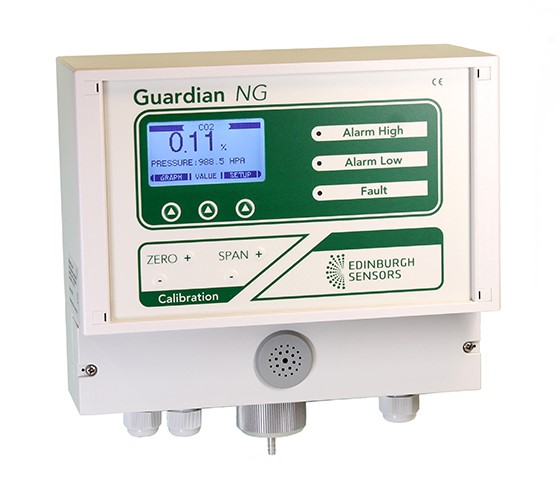
For SF6 monitoring, Edinburgh Sensors offer the Chillcard NG9 and the Guardian NG10. Both of these are robust, self-contained units that provide near-analyser quality continuous sampling.

The Chillcard NG and Guardian NG
The Chillcard NG can detect SF6 concentrations of 0 – 3000 ppm per volume at a range of 30 m. This means a single device offers excellent area coverage and is sensitive enough to detect even trace leaks. This level of sensitivity is particularly important for refrigerant gases, where even small concentrations can make a significant contribution to climate change.
With a response time of T90 = 30 s, the Chillcard NG can provide online gas monitoring and, using the digital RS232, can be connected to a data logging and alarm system. This means the Chillcard NG can be integrated into an automated, rapid response system, so as soon as a leak is detected, it can be quickly contained. The Chillcard NG system’s automated nature means that it can run continually and the risk of extended leaks is minimized.
The Guardian NG also offers similar opportunities for integration into online monitoring systems with the additional option of an Ethernet connection. Much like the Chillcard NG, the Guardian NG makes use of sophisticated onboard pressure and temperature compensation corrections to ensure the accuracy of measurements regardless of fluctuations in environmental conditions. Readings are compensated over 0-95 % humidity and up to 45°C.
Edinburgh Sensors is an expert in gas sensing and, as well as pre- and post- sales support, and can also offer custom solutions and recommendations for applications not covered by their standard range of products. For electrical power applications where SF6 use is still necessary, Edinburgh Sensors’ devices offer a way of monitoring and minimizing the gas’s potential environmental impact.
References and Further Reading
- Seeger, M., Smeets, R., Yan, J., Ito, H., Claessens, M., Dullni, E., … Yanabu, S. (2017). Recent trends in development of high voltage circuit breakers with SF6 alternative gases. 22nd Symposium on Physics of Switching Arc, 2017-September, 1–5. https://doi.org/10.14311/ppt.2017.1.8
- Chu, F. Y. (1986). SF6 Decomposition in Gas-Insulated Equipment. IEEE Transactions on Electrical Insulation, EI-21(5), 693–725. https://doi.org/10.1109/TEI.1986.348921
- Ehhalt, D., & Prather, M. (2001). Atmospheric Chemistry and Greenhouse Gases. Climate Change 2001: The Scientific Basis, 239–287.
- Regulation 517/2014, European Environment Agency (2020), https://www.eea.europa.eu/policy-documents/regulation-eu-no-517-2014, accessed 20th December 2020
- Rigby, M., Mühle, J., Miller, B. R., Prinn, R. G., Krummel, P. B., Steele, L. P., … Elkins, J. W. (2010). History of atmospheric SF6 from 1973 to 2008. Atmospheric Chemistry and Physics, 10(21), 10305–10320. https://doi.org/10.5194/acp-10-10305-2010
- Nsair, A., Cinar, S. O., Alassali, A., Qdais, H. A., & Kuchta, K. (2020). Operational Parameters of Biogas Plants: A Review and Evaluation Study. Energies, 13(15). https://doi.org/10.3390/en13153761
- Overview of SF6 emission sources, EPA, (2018), https://www.epa.gov/sites/production/files/2018-08/documents/12183_sf6_partnership_overview_v20_release_508.pdf, accessed 20th December 2020
- About Us, Edinburgh Sensors (2020), https://edinburghsensors.com/about/about-us/, accessed 20th December 2020
- Chillcard NG, Edinburgh Sensors (2020) https://edinburghsensors.com/products/oem-co2-sensor/chillcard-ng/chillcard-ng-2/, accessed 20th December 2020
- Guardian NG, Edinburgh Sensors (2020) https://edinburghsensors.com/products/gas-monitors/gas-monitor-guardian-ng/, accessed 20th December 2020