
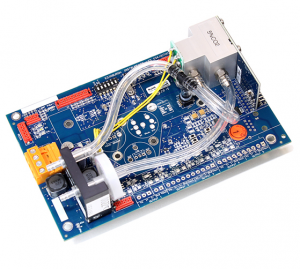
For example, the Gascard NG is an NDIR sensor capable of detecting carbon dioxide concentrations over a series of different ranges. For the relatively low short and long term exposure limits as part of indoor air quality applications, devices optimised for low concentrations of 0-10 % may be optimal.9 The excellent limit of detection means even the smallest of changes in gas concentration can be detected, making quick response to a potential problem feasible. The excellent zero stability, which is ±2% of range (over 12 months), also means that the sensor can be a reliable part of any environmental control network. While the Gascard NG is designed up to robust with minimum maintenance, all the parts are field-serviceable so any irregular or unusual maintenance will cause minimal disruption.
This means it is easy to integrate into feedback systems or data logging networks where real-time, regular sampling is required. Additional options include the use of the data logging software provided with the sensor, which simply requires a cable connection to start. For more complex, custom solutions where more extensive integration or advice is needed, Edinburgh Sensors offer full pre- and post-sales technical support and the possibility of bespoke design.
The Gascard NG has been designed to work in a variety of field conditions, including having temperature, pressure, and humidity compensated measurements. The sensor will remain accurate over 0 – 95 % humidity conditions so even in the challenging and potentially highly variable conditions of a centralised HVAC space, the Gascard NG can be relied upon to continue providing accurate readings. It is also possible to collect regular and rapid readouts, with a T90 of just 10 seconds, making the device highly effective for either safety or environmental monitoring purposes.
Stay in touch
If you have enjoyed reading this article about centralised HVAC systems and would like to find out more about our range of gas sensing technology, please don’t hesitate to get in touch with a member of our team today.
In addition, why not join Edinburgh Sensors on social media and sign up to our infrequent eNewsletter to be the first to know about our latest products, research and developments.
References and Further Reading
- UK HSE (2020), https://www.hse.gov.uk/temperature/law.htm, accessed 01/03/2020
- Akimoto, T., Tanabe, S. ichi, Yanai, T., & Sasaki, M. (2010). Thermal comfort and productivity – Evaluation of workplace environment in a task conditioned office. Building and Environment, 45(1), 45–50. https://doi.org/10.1016/j.buildenv.2009.06.022
- Pérez-Lombard, L., Ortiz, J., Coronel, J. F., & Maestre, I. R. (2011). A review of HVAC systems requirements in building energy regulations. Energy and Buildings, 43(2–3), 255–268. https://doi.org/10.1016/j.enbuild.2010.10.025
- Centralized HVAC (2009), http://www.seedengr.com/Cent%20Vs%20Decent%20AC%20Systems.pdf, accessed 04/03/2020
- HSE on SBS (2020) http://www.hse.gov.uk/pubns/priced/hsg132.pdf, accessed 03/03/2020
- Li, J., Wall, J., & Platt, G. (2010). Indoor air quality control of HVAC system. 2010 International Conference on Modelling, Identification and Control, ICMIC 2010, 756–761.
- Bhattacharya, S., Sridevi, S., & Pitchiah, R. (2012). Indoor Air Quality Monitoring using Wireless Sensor Network. Sixth International Conference on Sensing Technology, 422–427.
- OEM Sensors (2020), https://edinburghsensors.com/products/oem-co2-sensor/, accessed 28/02/2020
- Gascard NG (2020), https://edinburghsensors.com/products/oem-co2-sensor/gascard-ng/, accessed 28/02/2020
